|

|


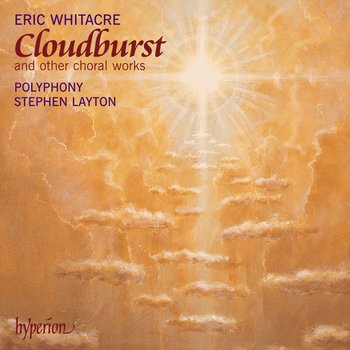
Eric Whitacre Cloudburst
and other choral works
 |
Grammy Nomination 2007

Polyphony
Stephen Layton conductor
Robert Millet percussion
Stephen Betteridge piano

Rochester City News
Polyphony: “Cloudburst”
by Eric Whitacre
Jan 16th 2007

Polyphony, Stephen Layton, cond. (Hyperion)

For months I've been driving around entranced, listening to Cloudburst, a stunning CD from British choral group Polyphony. All of the songs on the disc are by 30something American composer Eric Whitacre, who has a way of contracting and expanding chords with carefully crafted dissonance and resolution. Members of Polyphony, directed by Stephen Layton, sing of sleep, love, dreams, passion, and death. "A Boy and a Girl," based on a poem by Octavio Paz, evokes the sight of two lovers on the grass, first stretched out on top of it, then stretched out beneath it. It's Iron and Wine's "Teeth in the Grass," only spun out on a fine, silken thread of unaccompanied voices and exquisite poetry. It leaves me breathless.

I'm not the only one who thinks Cloudburst is amazing. The 2006 Hyperion CD is up for a Grammy for best choral performance. Listen and see if it doesn't leave you suspended, too.

Encore: The performing Arts Magazine
Cloudburst and other choral works
by Eric Whitacre
May 2006

Polyphony, Stephen Layton, cond. (Hyperion)

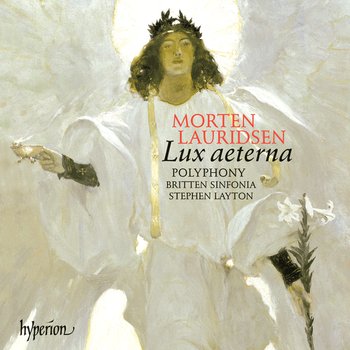
A lifetime of listening to choral music had not prepared me for such lush harmonies—a cappella voices perfectly tuned and blended. This was my first encounter with Polyphony, possibly the best small (25 or so) professional chorus in the world. Polyphony is from Britain, where choral singing is a national fetish. Since their formation in 1986 by conductor Stephen Layton, they have amassed an impressive catalogue on the Hyperion label, which also includes the highly praised, Grammy-nominated recording of Morten Lauridsen’s Lux Aeterna. But for pure Polyphony, the group’s CD Cloudburst, comprised entirely of works by wunderkind composer Eric Whitacre, is a stunning recording, their best showcase yet. The usual four-part harmonies are just a starting point for Whitacre’s complex harmonic writing. His compositional style employs frequent dissonance for its sheer beauty, as seconds, elevenths and thirteenths serve as passing tones, or crowd together in tight, but perfectly articulated clusters of notes, always in service to a beautiful vocal sound. Whitacre’s texts include settings of e.e. cummings, Octavio Paz and others. But the star of this gorgeous recording is Polyphony. Headphones are recommended.

BBC Radio CD Review
18 Feb 2006

Right. Stop making the coffee: leave the washing for two minutes, muzzle your children, pull over to the side of the road and listen to this.

Whitacre – I thank You God

This is the music of Eric Whitacre and if you haven’t heard about him you’re surely about to in a big way and there could be no better place to start than a new recording entitled CLOUDBURST dedicated entirely to his choral works, sung by Polyphony conducted by Stephen Layton.

Whitacre was born in 1970 north of San Francisco. His musical education was patchy; he played in a marching band, synth in a techno-pop band and then got tricked into joining the choir (‘there were a lot of cute girls in the soprano section’) which changed his life. And why not?

There’s nothing technically new about Whitacre’s writing. There’s more than a sniff of the new world of Aaron Copland about him and you can hear the consecutive chording of a man writing basic stuff at the piano.

But what hits you straight between the eyes is the honesty, optimism and sheer belief that passes any pretension. This is music that can actually make you smile if you open yourself up to it!

That doesn’t stop him exploring darker moods. Here’s the opening of ‘When David heard that Absalom was slain’, the terrible lament of a man for his dead child.

Whitacre – When David heard

And that’s only the beginning. Over the next 10 minutes Whitacre presents various grief-inspired motifs (reminding one strongly of Arvo Pärt) which he then combines to an incredible climax. And this is perhaps Whitacre’s achievement - his superlative pacing, to which you can add a love of and commitment to words and an understanding of consonance, the whole infused by that incredible belief in his idea, without any angst over whether someone somewhere else might have used the style before.

That’s the music but it’s just notes on the page without a matching performance and this it utterly receives from Polyphony and conductor Stephen Layton. You might make the mistake of thinking that the music was somehow simple to perform but its requirements are considerable. Note clusters don’t sing themselves, they require fine-tuning and the voices have to sing without vibrato for much of the time in exposed parts of their range. And Layton’s pacing is also excellent.

The previous four choirs reviewed today are bodies that sing together regularly with a regular line-up, the two European ones generously funded. Like many British vocal ensembles Polyphony’s membership is fluid and what’s more this whole project was put together from scratch (rehearsal and recording) in 3 days: unimaginable anywhere outside this island though fairly standard over here. Layton has assembled a wonderful mix of London’s very finest and (more to the point) most suitable singers for this music fronted by Elin Manahan Thomas, Julia Doyle and Gracie Davidson among others on soprano. Credit also to producer Adrian Peacock who has done a great job.

This is a staggering disc and a hugely attractive one that you will want to play to your friends. As a final ‘amuse-bouche’ enjoy the end of the poem ‘Sleep’ and then go and buy yourself the disc.

Whitacre - Sleep
Chicago Tribune
Whitacre: Cloudburst and other choral works
February 17, 2006
John von Rhein

Polyphony, Stephen Layton, conductor (Hyperion)
 Composer Eric Whitacre's new Hyperion release marks a most enjoyable collection of his works for (mostly) unaccompanied chorus.

Whitacre's overnight rise to becoming one of America's most successful choral composers is nothing if not remarkable. Like many of the younger generation of composers, he was raised on an omnivorous musical diet that made no distinction between "high" and "low" art. He grew up playing rock and got turned on to choral music when he joined his college choir--lured less by the music, he admits, than the cute sopranos. He went on to achieve a master's degree at the Juilliard School.

The 14 works on this CD, dating from 1991 to 2004, are settings of poets as diverse as Dickinson, Lorca, Cummings and a 13th Century Persian Sufi mystic. It's easy to hear why choruses and audiences respond to his music: It's singable, beautifully crafted, rooted in traditional tonal harmony, yet lightly spiced with piquant suspensions and other coloristic devices that reveal a deeply poetic sensibility. In all, a considerable achievement for a composer of 35.

The superb English choral ensemble Polyphony performs Whitacre's music with dedication and sensitivity, bringing out the floating, shimmering qualities conjured by the words and music. For many listeners, the Hyperion disc will make a fine introduction to a young composer who--to judge from these selections--was born to write choral music.

Copyright © 2006, Chicago Tribune

BBC Music Magazine


Classic FM Magazine


Classics FM Hot Property
15th September 2006

Please click on the image below to download the full PDF.


www.musicweb-international.com
February 2006
John Quinn

Last year Stephen Layton and Polyphony gave us a very fine CD devoted to the music of the American composer, Morten Lauridsen (b.1943)

Now they follow that up with a programme of music by another, younger American composer, Eric Whitacre. Simply as a point of reference I’d say that anyone who responds positively to Lauridsen’s music should warm equally to Whitacre’s muse. I first encountered his work last year when I reviewed a CD of Christmas music that included ‘Lux aurumque’, with which this present CD concludes, I was impressed and intrigued by the piece so I was keen to explore Whitacre’s music further with Polyphony’s help.

Eric Whitacre was born in Reno, Nevada. In the very good liner notes accompanying this disc Meurig Bowen reveals that the young Whitacre had "a musical upbringing that matched the lack of focus and patchiness of most of his contemporaries". Despite that he was admitted to study music at the University of Las Vegas, whence he proceeded to the Juilliard School of Music in 1995 to study with John Corigliano and David Diamond.

There is some very beautiful music on this CD. The harmonies are often rich and close and to my ears Whitacre has a real feeling for how to write for the human voice. I doubt his music is easy to sing but he makes no outlandish demands on his singers and the music unfailingly falls gratefully on the ear and complements very well his chosen texts.

I think it’s worth quoting what Meurig Bowen has to say about Whitacre’s music. It is very aptly described thus: "Purity, directness of expression, a keen sense of climax and anti-climax, a wide-eyed receptiveness to moments of ecstasy: these are constants and key characteristics in [his] often sublime music. By the standards of the last century’s more adventurous choral explorations, it is fundamentally conservative music, with few surprises or innovations harmonically or rhythmically." If the contents of this CD are representative of Whitacre’s output to date then I think that verdict is very fair and accurate. It has to be said that much of the music is slow moving and listeners may not want to hear the whole disc at one setting. But the music always sounds to me to be expertly crafted and its sincerity and the ease with which Whitacre communicates demand respect. It’s firmly rooted in and respectful of the traditions, vocabulary and syntax of Western choral music and none the worse for that.

The recital opens with a shrewd choice in the form of a setting of e.e.Cummings’s poem, ‘i thank You God for most this amazing day.’ The effect that Whitacre achieves here is quite splendid, rising from a quiet, simple beginning to a burst of fervent openhearted choral harmonies. It’s memorable and arresting. Don’t ask me why, since this is an entirely subjective and instinctive opinion, but it seems to me that only an American could have written that phrase. The rest of the setting lives up to the promise of the opening. The other two Cummings pieces are equally successful. Since the composer himself has referred to the three pieces as a cycle I’m a little puzzled as to why they are separated on the disc but listeners can programme their players to hear the settings consecutively.

Whitacre’s skill in placing and sustaining a climax is evident in several pieces, not least at the heart of ‘Sleep’ where the music is powerful and impressive. Perhaps the most individual piece on the disc is ‘Cloudburst’ itself. This is the only piece that involves any instrumental accompaniment. In this piece more vocal effects are used than elsewhere but these add significantly to the range of Whitacre’s palette of colouring. At the climax (track 8 from around 6:00) Whitacre deploys piano, wind chimes, thunder sheets and handbells and the singers are also required to clap their hands, click their fingers and slap their thighs. This written description doesn’t begin to do justice to the composer’s imagination, I readily admit. The climax is, in fact, overwhelming and creates the illusion of a tropical rainstorm with amazing reality. It’s highly original and effective.

Less effective, I fear, is the longest piece in the programme, ‘When David heard’. Here, I find, the trouble is the repetitive nature of the music. Small musical fragments are repeated time and again before, it seems, Whitacre moves on to the next fragment, which, again, is often the subject of excessive repetition. I honestly feel that were the piece to be pruned to half its length it would be much the better for it since it contains some good ideas, such as the impressive hushed opening. If I may say so, one has only to think of the infinitely more succinct setting of the same text, albeit in a very different idiom, by Thomas Weelkes, to realise that economy of means and gesture can be most effective.

However, the remainder of the programme is much more successful. I can imagine that the simple and very beautiful ‘This Marriage’ will become a popular favourite – and so it should. ‘Lux aurumque’, to which I’ve already referred, is another fine piece and I was greatly taken with the grave beauty of ‘Water Night’, another piece in which dynamic range and climax are used most effectively. ‘Her Spirit Soars’ is a most impressive piece indeed and here the music is built most convincingly to a magnificent and ecstatic final climax.

The singing of Polyphony under Stephen Layton’s discerning direction is superb throughout. The recorded sound is first rate. The choir is recorded clearly and with just the right amount of space around the voices. The excellent notes are provided in English, French and German and the full texts are supplied.

This is a very fine disc indeed. I’ve enjoyed it greatly and now that I’ve had the chance to sample more of Eric Whitacre’s music I believe that he’s a highly significant composer with a very genuine gift for choral writing and one, moreover, with that priceless ability to communicate strongly and effectively with his audience. I hope that this disc will be widely heard; it deserves to be. I have absolutely no hesitation in recommending it.

The Times


Classics Today
15th September 2006

You hear about huge advance orders for the latest CD by the biggest, hottest pop superstar, or for the most fashionably hip tell-all book--but when the buzz is about a CD of classical choral music? Yes, there have been big
successes by vocal groups during the last decade or two – Anonymous 4, the King's Singers, the Choir of King's College, Cambridge, the Tallis Scholars, the Bulgarian women's choirs, and don't forget those Spanish monks – and by choral composers, including the abundantly popular John Rutter, the eminently revered Arvo Pärt, and the currently faddish and always challenging texturalist Morten Lauridsen. Even the sparsely talented
John Tavener managed to make a mark, and his contined output of pretentious and opportunistic creations shows just how wide and open-armed the choral music world can be.

And then there's Eric Whitacre, a 35-year-old American composer who in a few short years has carved more than just a niche: his music has captured the hearts and minds of singers, conductors, and vocal music fans across
oceans and continents. According to his press materials, his piece Water Night "has become one of the most popular choral works of the last decade...one of the top selling choral publications in the last five years", and his published works "have sold more than 350,000 copies worldwide." On hearing the 14 selections on this CD – and after a memorable encounter with his new work A Boy and a Girl (premiered on this disc) at a national
choral convention last year--I can only say that the acclaim and attention is well deserved.

You could say that Whitacre is the "anti-Tavener"; in other words, he's fiercely, organically original. His use of harmony and unusually knowing way with choral "effects" comes from an internal hearing and unique imagining, not from what he thinks may be the "next cool thing". Neither do his works carry anything close to the immediate accessibility of Rutter's melody-driven community and church choir favorites, nor are they reminiscent of the time-altering, "mystical" intonations of Pärt or the close-harmony, inverted-chord style of Lauridsen--although elements of all three are present to some degree.

Whitacre, a consummately thoughtful composer, is an original voice, his
compositions firmly rooted in and arising from the texts – and it's this respect for the words and their meaning that leads him to choose his texts well, favoring the quirky but powerful creations of E.E. Cummings, the bold
simplicity of Emily Dickinson, and the vividly imagistic, penetratingly romantic expressions of Lorca and Paz. And he's not only interested in the words, but in the musical colors and textures they suggest relative to vocal
sound.

Whitacre has a thing he does with shifting chords, sudden and strangely startling harmonic alterings that seem to involve only very subtle changes of pitch – but nevertheless kind of throw you, but not in an unpleasant way. He does this in different ways and contexts in many of his pieces (I hide myself; Lux aurumque; the final minute of Sleep; throughout A Boy and a Girl)--and the effect, while hard to describe, is kind of like that guttingling
sensation caused by a sudden downhill swoop when driving over a back road. Who doesn't want to go back and do it again? Well, you'll want to experience these harmonic "tingles" over and over, not because they're gimmicks, but because they are so poignant and so perfectly illuminate the poetry.

Whitacre constantly seems to be experimenting with and expanding the functional possibilities of chords, preparing us for one thing and then offering another, yet more elegant and satisfying solution, extending a phrase with some sort of thick-textured, bass-heavy dissonance, or suddenly breaking up the flow with alternating rests and short melodic/harmonic utterances. And Whitacre is quite the dramatist, knowing just how to develop a work musically to bring us to a satisfying conclusion every time. It can be quiet and soulwarming – or, as in the ending of Her sacred spirit
soars, as heart-stoppingly electrifying as anything you've ever heard in an a cappella choral work.

There are so many gorgeous and deeply moving moments among these works, my favorites being Go, lovely Rose, Lux aurumque, and the scintillating masterpiece A Boy and a Girl. I'm not that fond of the too-long-for-its-material When David heard, and some of the very interesting and ingenious percussive effects in Cloudburst don't come off so well on a recording – but this is the work of a significant composer whose artistic talent is genuine and whose success so far has come entirely from the quality, originality, and sincerely-won appeal of his music. No weird artificial persona, no mystical religious conversions, no irrelevant extramusical indulgences. How refreshing! And he's fortunate to have such committed, adventurous, world-class musical advocates as Stephen Layton and Polyphony – not to mention the folks at Hyperion – to present his music so convincingly. Simon Eadon's engineering, from London's Temple Church, is top-notch, and Meurig Bowen's very readable, informative notes complete a
package that ranks as one of the truly worthwhile recording events of 2006.

David Vernier

http://theovergrownpath.blogspot.com
Eric Whitacre outsells Mozart
Thursday, February 23, 2006

How to reach new audiences is a continuing preoccupation of the 'serious music' community. Yet just this week a surprise classical best-seller has shown how to do it. You don't need dumbing-down, the latest avant-garde tricks, classical music night-clubs or free Beethoven MP3s. What you need is great contemporary music which is innovative, honest and accessible. It needs to be recorded by an enterprising label, with top-class performers and engineering. It also needs to feature a marketable personality and be supported by the media. Cloudburst, a CD of Eric Whitacre's choral works sung by Polyphony, is currently the surprise UK classical best seller. It hit all the hot buttons, and proves that a full price CD of music written in the last fifteen years can outsell the TV promoted greatest hits of a dead guy from Salzburg.

Andrew Cane of leading UK independent classical store Prelude Records explained to An Overgrown Path yesterday: "Cloudburst had been out for two weeks when BBC Radio 3's CD Review gave it an outstanding review. Then the rush started, and we took more than ten orders just on Saturday. That was double our next best seller - a TV advertised 'Best of Mozart' compilation. Sales of Cloudburst have also been very strong this week, easily outselling the big January release of the 2006 New Year's Day Concert conducted by Mariss Jansons. We are delighted, but it is really quite surprising as Eric Whitacre is almost unknown here." The success of Cloudburst has been reflected in the US where within a day of being released it entered the Amazon top ten classical best seller list.

Eric Whitacre was born in Nevada in 1970, and played synthesizers in a teenage techno-pop band before graduating from the Juilliard School of Music where he studied with John Corigliano and David Diamond. His musical voice is unique but fundamentally conservative, and he has been described as the 'anti-Tavener' because of his disregard for fashions such as the so-called 'holy minimalism', although the setting of the biblical text When David heard does pay homage to Arvo Pärt. It is no bad thing, but I do also clearly hear the influence of another unique voice in the form of Peter Maxwell Davies(right), particularly Max's 1981 Lullabye for Lucy. (Opening the link launches an audio file of this sublime work). Whitacre is a master of harmony, but is a million miles away from the 'comfort music' of John Rutter and others. Despite Eric Whitacre's popular appeal there is no complacency in his writing, and he keeps the listener on the edge of their seat with shifting chords and startling harmonies that confirm his pop/rock roots. Above all it is his ability to make music the servant of words that distinguishes his vocal works, and this is reflected in his eclectic choice of texts.

Whitacre's choral works, which include Water Night, Cloudburst, Sleep, Lux Aurumque and A Boy and a Girl, are hugely popular in the US, and his compositions for symphonic winds are also frequently programmed, particularly Ghost Train which has had over a thousand performances and forty recordings. One of his most recent compositions is Paradise Lost (production shot right). He describes this, his first work for stage, as an 'opera electronica', and it combines trance, ambient, and techno electronics in a genre crossing combination of choral, cinematic and operatic forms.

Cloudburst was recorded by Hyperion, and takes it name from one of Eric Whitacre's best known choral works which sets a poem by Nobel Prize winner Octavio Paz. The CD features fourteen settings of poets as diverse as Dickinson, Lorca, Cummings and a 13th Century Persian Sufi mystic. It was recorded in just three days with Stephen Layton directing the vocal ensemble Polyphony who do not include Whitacre in their core repertoire.

Polyphony are outstanding in any music, and they rise magnificently to the new challenges set by Eric Whitacre. The lines are exposed and there is no vibrato to hide behind, yet the result is one of the best choral releases I have heard for years. All credit to Hyperion for this innovative release, and to Simon Eadon’s superb engineering in London’s Temple Church (where Stephen Layton was Director of Music). The sound is demonstration quality, particularly in the title track which features piano, percussion, handbells, thunder sheet, wind chimes, a suspended cymbal and, shades of Max, a children's choir.

To remind us all how to reach new audiences here is no less than five minutes of glorious choral singing from Cloudburst in the form of Eric Whitacre's Water Night -

Web resources: * Eric Whitacre * Polyphony * Stephen Layton * Prelude Records * Hyperion * Peter Maxwell Davies *

posted by Pliable at Thursday, February 23, 2006
<back
|